Forward Observer Training -
New Features
The forward observer training features were developed as part of an internally funded IRAD project connected to a contracted initiative. Because the work was IRAD, we had flexibility in defining requirements and setting direction. However, limited development time required us to pursue solutions that minimized technical impediments while still delivering meaningful functionality.
Forward Observer Training: Project Overview
My Role:
Senior UX Designer
Team:
Team Size: 9
PO
3-6 BE Developers
FE Developers
2 Technical Designers
2 QA
UX designer
Duration:
4 months
Deliverables:
I was responsible for Stakeholder, SME & User interviews, Use Cases, Flow Diagram, Personas, Wireframes, Prototypes, UI Kit and Style Guide, Usability Testing, Iconography,, and Final UI design.
Process:

Discovery
Research
Interviews
Existing user issues
Company expectations

Define
Use cases
Users
Flow diagram
Personas

Ideate
Sketches
Wireframes
Brainstorming
Prototypes
User testing

Design

Final Design & Launch
Mock ups
Visual Design
UI Kit / Style Guide
User testing
Final design docs
UX/UI Review
Tools:


Forward Observer Training: Research & Discovery
Challenges:
One challenge stemmed from timing. Although the contract was signed, there was a delay of several months before development could begin. As a result, the assigned work had to be split between two teams under one PO in order to meet deadlines. To prevent issues, the two teams were treated as a single unit, requiring extra coordination.
Because this effort was an IRAD tied to a paid contract, the company was cautious about costs, which placed financial constraints on the project. These constraints often amplified stakeholder influence, with opinions being pressed more strongly into the design process.
Another challenge was determining where within the product the new features could be placed in a way that balanced user expectations with technical feasibility. I collaborated with the PO and technical designers to explore multiple options and conduct user testing, always prioritizing the path with the least development overhead. Once the most feasible solution was identified, we refined it to meet user needs as effectively as possible.
A recurring issue across this and other projects was conflicting stakeholder input. External stakeholders occasionally attended sprint demos, introducing mixed messages, requiring justification of design decisions, and sometimes leading to rework. In some cases, stakeholders who missed a demo would later oppose a decision that had already been agreed upon, creating additional challenges for alignment and momentum.
Accomplishments:
While attending ITSEC, I had the opportunity to meet with the contracting company and learn directly about their typical training scenario setup. This conversation provided valuable context for the training use case and allowed me to ask targeted questions that informed design decisions.
The streamlined design, simplicity, and functionality of the final implementation were very well received and ultimately showcased as an example for other teams to reference in their own work.
Lessons learned:
With each project I learned to be more flexible with direction changes, scope limitations and discovering “why.” The reasons behind the requests will sometimes yield actual motives and allow for a more unified direction that coincides with what is already developed with minimal changes. Asking why every step of the way and not just during the research and user testing process results in a more well rounded bucket of knowledge to design from.
What didn't work:
One challenge was the way the Product Owner positioned me as a separate resource rather than a fully integrated member of the team. Despite my efforts to be more involved, I was not invited to certain team meetings that the PO assumed would not be valuable for me. This created a gap between myself and the rest of the team, limiting opportunities for alignment and collaboration.
Even with this limitation, I was still able to succeed in my role and deliver a strong outcome, but it highlighted the importance of ensuring UX is fully embedded within cross-functional teams.
Research:
After reviewing the requirements, my research focused on understanding how the four new features would be used in forward observer training, how they related to one another, and whether they were interconnected. I also investigated how forward observer training missions were created and conducted, including the setup of training rooms and the environment in which both instructors and trainees operated. This context helped ensure the features were designed to align with real-world training practices and user workflows.
Since access to customers is limited in the military simulation space, I was able to gather a large amount of these answers during the ITSEC convention. The customer was there with a typical set up for forward observer training and was able to demo the training and answer questions.

Interviews with SMEs:
I conducted interviews and conversations with several subject matter experts, including the PO, two senior managers, and the BD. These discussions provided insights into business requirements, the target users, envisioned functionality, competitive products, and other high-level considerations.
The most significant takeaway was that although this project was tied to a paying contract, it was being funded internally. This created a tighter budget while giving us more control over design and implementation decisions. It also meant stakeholders were especially invested in the project’s success and closely involved throughout development.
Interviews with users:
We did not have direct access to the end users. The contract was with another military simulations company, who in turn had the relationship with the actual end users. This arrangement meant that all user input had to be filtered through the contracting company and supplemented by the BD’s knowledge of the users. While this limited our ability to conduct firsthand interviews, it highlighted the importance of collaborating closely with intermediaries to gather accurate customer insights.


Forward Observer Training: Define
Research:
After reviewing the requirements, my research centered on understanding how the four proposed features would be used in forward observer training, how they related to one another, and whether they were interconnected. I also examined how forward observer training missions were created and conducted, how training rooms were typically set up, and what the environment was like for both mission creation and live training sessions. This context helped ensure the features aligned with real-world practices and user workflows.
Since direct customer access is limited in the military simulation space, I leveraged the I/ITSEC convention to gather critical information. The customer had a typical forward observer training setup on display, which allowed me to see the training process firsthand. They also demoed the workflow and answered questions, providing valuable insights that would have been difficult to obtain otherwise.

Use Cases:
The use cases aligned with the four features being developed. Of the five listed below, two represented different functionalities of the same feature, and were therefore designed together during ideation. This ensured the features complemented one another and worked cohesively within the training workflow.

Flow Chart:
Each feature was mapped out in its own flow chart, since their use cases were not interdependent. As development progressed, the charts were updated to reflect workflow revisions that arose from technical limitations, ensuring alignment between design intent and implementation.


Forward Observer Training: Define
Sketches:
Following discussions with the PO and stakeholders, I created sketches to begin brainstorming requirements and functionality for each feature. These early visuals helped translate abstract ideas into tangible concepts and served as a foundation for further design exploration.

Digital exploration:
Because this project was being integrated into an existing product, we first needed to determine the most intuitive access points for the new features based on user expectations. User testing was conducted to validate where participants anticipated finding these features.
All successful access point options were then presented to the development team, who evaluated the time cost of implementing each one. Once the location was finalized, I explored layout options for each feature. From these explorations, we aligned on a final direction to move forward with.

Wireframes Prototypes:
To quickly test how the features would flow, I created wireframe prototypes and first ran through them myself before testing with the QA department (since direct user access was not available). Feedback from these sessions highlighted recurring usability issues, which informed workflow adjustments. Once refined, the wireframes served as the foundation for full-color prototypes that could be used for further validation.


Forward Observer Training: Prototype & User Testing
Prototype - High fidelity:
A full-color prototype was created to test all four features, designed so users could access each within a single build. This approach allowed us to evaluate whether participants could successfully navigate the complete workflow across the application.
Once the prototype was complete, we developed test scenarios targeting specific tasks. Users were then asked to work through these tasks, which required them to navigate the application and validate the end-to-end flow.

User Testing:
Because I had to rely heavily on internal resources for testing, my primary goal was to ensure users could locate the new features and use them successfully. Since the features themselves were not overly complex, this level of testing was sufficient to validate usability.
Multiple testing sessions were conducted throughout development, including:
-
A/B testing
-
Click testing
-
Individual in-person testing (both local and remote)
One survey focused specifically on determining where users expected to access the new features. Additionally, in-person testing was conducted on the XD prototypes before development began. This early validation ensured users could understand the new features conceptually before beta builds were available for testing.
Testing Insights:
Several key findings emerged from these sessions:
-
A toggle labeled On/Off appeared in multiple features but proved unclear to users. Alternative labeling options were explored and retested.
-
An eyeball icon intended as a toggle for the Hidden Entities feature was misinterpreted by users. A tooltip was added to clarify its purpose.
-
A Cancel button tested as unnecessary and was ultimately removed, simplifying the interface.


Forward Observer Training: Style Guide & UI Kit
Style Guide & UI Kit:
The Style Guide and UI Kit for this project were derived from the company’s Master UI Kit, which I designed with support from the UX team. This ensured consistency across all company products while allowing each feature to remain visually aligned within the larger system.


Forward Observer Training: Final Design & Launch
Final Design:
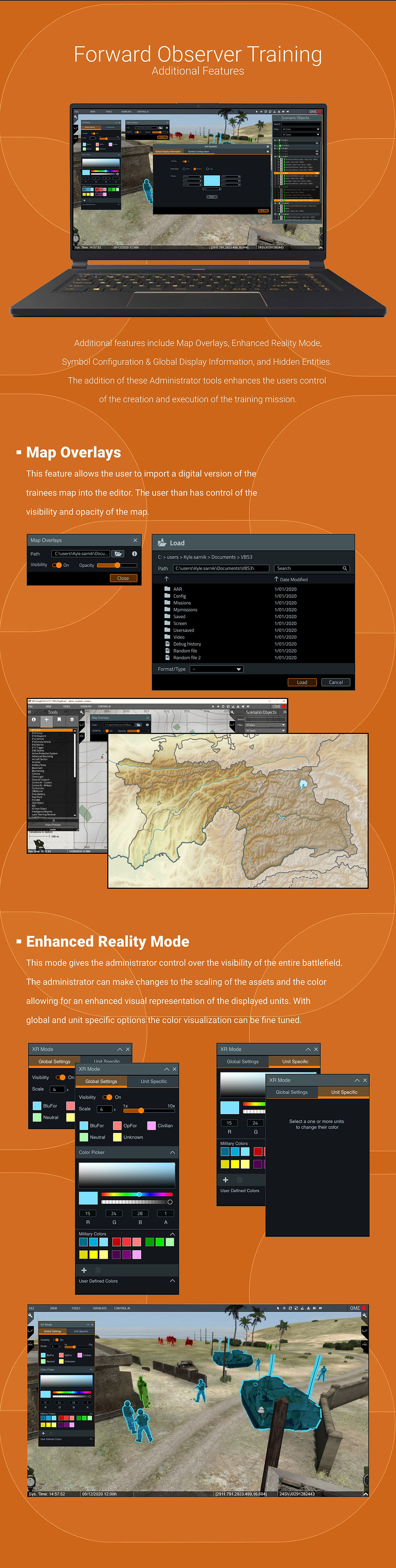
Here is the final design for the Forward Observer Training features, created to align with the updated design style of the main company product. The design and usability of these features were well received by both customers and stakeholders, reinforcing the value of the new approach.